Gridly
Overview
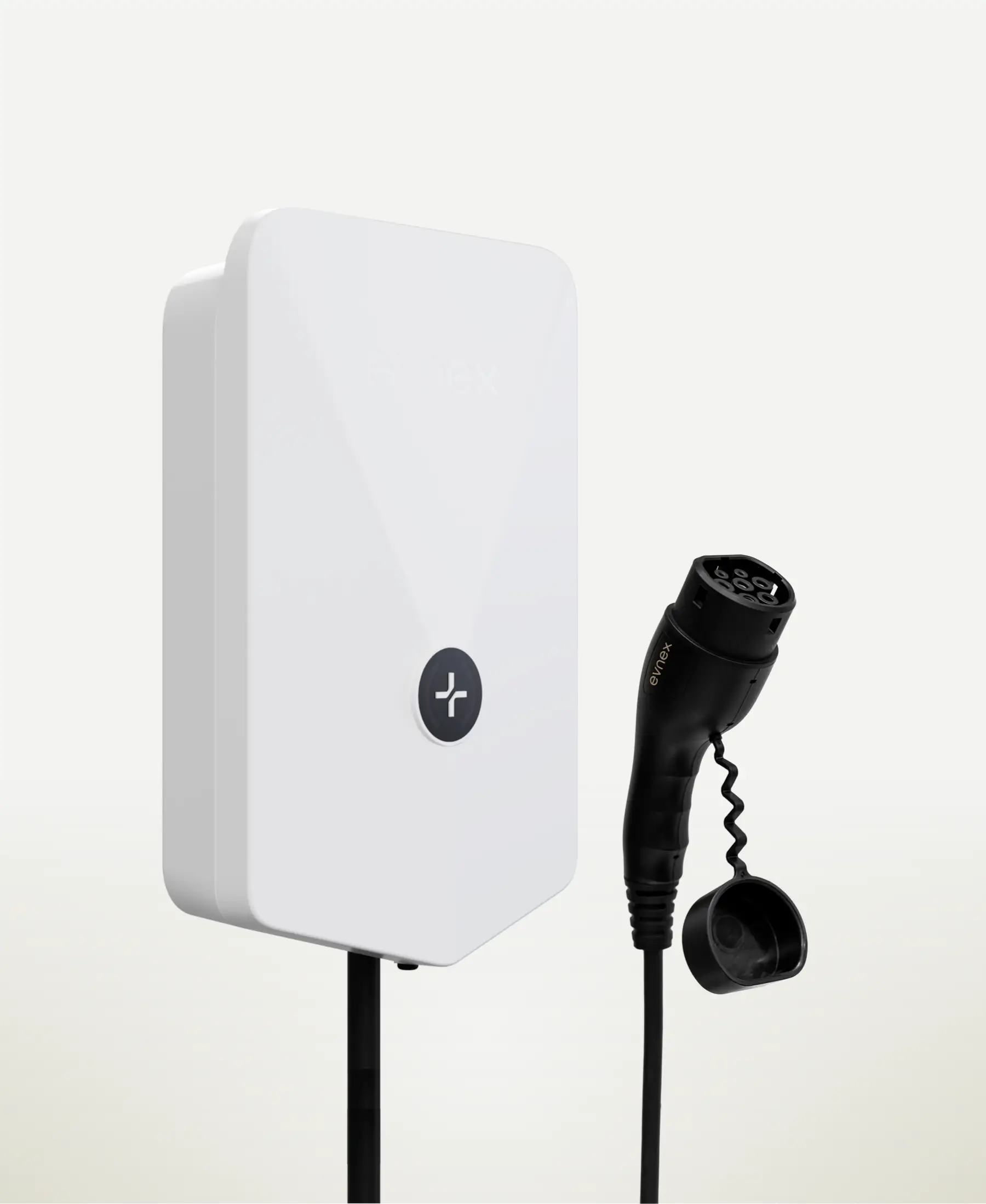
The Evnex E2 Core is the mid-tier product in Evnex’s E2 range - a step up from the socket-only E2 Flex, and below the solar-capable E2 Plus. At $999 with a 6m tethered cable, it delivers the smart charging features most households actually need without the premium for solar diversion.
Evnex is a New Zealand company that designs and engineers its own hardware, rather than white-labelling Chinese components under a local brand. That distinction shows in build quality, the depth of the OCPP implementation, and the confidence behind the 4-year warranty. Their Australian presence has grown steadily since the E2 range launched here in late 2025.
Total installed cost
Supply price is one number. What you actually spend to have a working charger on your wall is another.
| Cost component | Typical range |
|---|---|
| E2 Core supply | $999 |
| Licensed electrician installation | $400–$700 |
| Total all-in | ~$1,400–$1,700 |
Installation cost varies by switchboard proximity, cable run length, and your state’s electrician labour rates. Most standard metro homes land in the $400–$600 range for installation.
Compared to key alternatives installed:
- Evnex E2 Flex installed: ~$1,250–$1,600 (socket-only, bring your own cable)
- Wallbox Pulsar Plus installed: ~$1,800–$2,200
- myenergi Zappi installed: ~$2,000–$2,500
At $1,400–$1,700 all-in, the E2 Core is one of the most cost-effective smart charger installations available.
The 4-year warranty
The most important number in the E2 Core’s spec sheet is 4 years. At the $999 price point, the standard from competitors is 2 years - Wallbox, GoodWe, and Schneider all offer 2-year warranties at comparable prices. Four years on a charger handling daily sessions for a decade is practically significant: a fault developing in year 3 or 4 is covered rather than requiring an out-of-warranty replacement at your own expense.
The 4-year warranty is uniform across the entire Evnex E2 range (Flex, Core, Plus) and reflects Evnex’s confidence in the platform rather than a premium-tier exception.
OCPP: what it does in practice
OCPP (Open Charge Point Protocol) is the industry standard communication protocol for EV chargers. On the E2 Core it enables:
- Scheduled charging - set charging windows tied to your off-peak tariff. Most Australian time-of-use tariffs offer off-peak rates of 15–25 cents/kWh overnight versus 35–50 cents peak. For a household charging 15,000km per year at ~18kWh/100km, scheduling to off-peak can save $200–$400 annually.
- Remote start/stop - start or stop a session from the Evnex app without going to the garage
- Energy monitoring - track kWh consumed per session, monthly totals, and estimated cost
- Session history - useful for tax reporting (home office, work-related km)
- Load management - CT clamp monitors the main switchboard and reduces charger output if total home draw risks exceeding the main fuse rating
One important caveat: Evnex’s OCPP implementation is closed. The E2 Core communicates exclusively with Evnex’s own cloud platform, not with third-party OCPP backends like Home Assistant, SolarEdge, or commercial charge point management systems. For the typical household with one charger, this is not a practical limitation. For users wanting to integrate into a broader home automation setup, the Wallbox Pulsar Plus (open OCPP) is the alternative.
Load management
Load management is the feature that prevents the charger from tripping your main switchboard breaker. A standard E2 Core running at 32A draws significant current - combined with an electric oven, ducted air conditioning, and an instant hot water system, it can exceed the main fuse rating in older Australian homes.
A CT clamp installed at the switchboard monitors total household current draw in real time. When combined load approaches the fuse limit, the charger automatically reduces its charge rate. When other loads ease off, it ramps back up. The whole process is invisible to the user.
This is particularly relevant for:
- Homes with 40A or 60A main supply (older builds)
- Apartments where electrical capacity per dwelling is constrained
- Homes with multiple high-draw appliances running simultaneously
6m tethered cable
A 6m tethered Type 2 cable comfortably covers most Australian residential configurations. For chargers mounted near the garage entry or on an exterior wall beside a carport, 6m provides reach to front and rear charge ports on most vehicles.
The practical advantage over a socket-based charger (like the E2 Flex) is daily convenience: pull up, grab the cable, plug in. No cable management required, no separate cable stored in the boot. Over years of daily use, the small friction reduction is genuinely appreciated.
The cable uses a standard IEC 62196-2 Type 2 connector. If the cable is damaged, it can be replaced - contact Evnex for service options.
E2 Core vs key alternatives
| Evnex E2 Core | Wallbox Pulsar Plus | myenergi Zappi | GoodWe HCA | |
|---|---|---|---|---|
| Price (supply) | $999 | $1,299 | $1,499 | $850–$950 |
| OCPP | Closed 1.6 | Open 1.6 | Proprietary | Open 1.6 |
| Solar integration | No | No | Yes | With GoodWe inverter |
| Load management | Yes | Yes | Yes | No |
| Warranty | 4 years | 2 years | 3 years | 2 years |
| Cable | 6m tethered | Socket | 6.5m tethered | Socket or tethered |
The E2 Core’s strongest position is warranty-plus-load-management at the lowest price among tethered smart chargers. The Wallbox Pulsar Plus costs $300 more and offers open OCPP but a shorter warranty. The GoodWe HCA is cheaper but lacks load management and has a 2-year warranty.
Who should buy the E2 Core
Best for:
- Households wanting a tethered smart charger with scheduling and load management at the best price-to-warranty ratio available
- Buyers who don’t have solar or don’t need to charge from solar surplus
- Older homes with limited main supply where load management is specifically needed
- Anyone who values warranty length and wants confidence in the purchase
Skip if:
- You have rooftop solar and want to charge from surplus - upgrade to the E2 Plus ($1,299), which adds CT clamp solar integration for $300 more
- You need open OCPP interoperability with third-party platforms - consider the Wallbox Pulsar Plus ($1,299) or ZJ Beny ($700)
- You want the absolute lowest price and are comfortable managing your own cable - the E2 Flex ($799) is identical in features at $200 less
For a full comparison of the E2 range and how Evnex stacks up against the competition, see our Evnex charger review and brand overview.