Gridly
Overview
Hyundai took a different approach with the Ioniq 6. Where the Ioniq 5 prioritises interior space and a distinctive upright silhouette, the Ioniq 6 is shaped entirely around aerodynamic efficiency. Its 0.21 drag coefficient is the lowest of any production car in the world - lower than the Porsche Taycan (0.22), lower than the Tesla Model 3 (0.23). That number has a direct consequence: the Ioniq 6 extracts 614km of WLTP range from a 77.4kWh battery, a larger number than the Ioniq 5 achieves with an 84kWh pack.
The shape is deliberate and polarising. The Ioniq 6 draws visual references from the Porsche 911 and from concepts that prioritise the continuous surface over detail complexity. Australian buyers either find it compelling or forgettable - but the aerodynamic calculation behind the shape is unambiguous. This car goes further on a charge, and charges faster, than anything else Hyundai sells at this price.
Pricing & Variants
| Variant | Battery | WLTP Range | Drive | 0-100 | Price |
|---|---|---|---|---|---|
| Ioniq 6 RWD | 77.4kWh | 614 km | RWD | 5.9s | ~$66,900 |
| Ioniq 6 AWD | 77.4kWh | 583 km | AWD | 3.5s | ~$76,900 |
The Ioniq 6 range in Australia is two variants. The RWD uses the same 77.4kWh pack as the AWD but carries less mass and benefits more from the aerodynamic shape, producing both more range and a more economical daily running cost.
Performance
The rear motor produces 168kW and 350Nm. The 5.9-second 0-100 result is sharper than the number suggests - EV torque from rest means the initial acceleration is confident and decisive. Mid-range response from 80 to 120 km/h is the more important measure on Australian roads, and the Ioniq 6 delivers without hesitation.
The streamlined body generates minimal aerodynamic resistance at motorway speeds, which means the efficiency advantage extends beyond WLTP testing: at 110 km/h, the Ioniq 6 genuinely uses less energy per kilometre than most competitors. This is a measurable, daily-driving benefit, not a test cycle abstraction.
Ride quality reflects the Ioniq 6’s mission. The suspension is tuned for comfort over extended distances rather than sport, and the low drag body means wind noise at motorway speed is particularly well suppressed - comparable to cars in a higher price category.
Range and Charging
614km WLTP translates to approximately 500 to 545km in real-world Australian highway conditions at 110 km/h with climate control. That puts Sydney-Canberra (280km) and Melbourne-Sydney (880km with one stop) within confident reach without charge anxiety on either route.
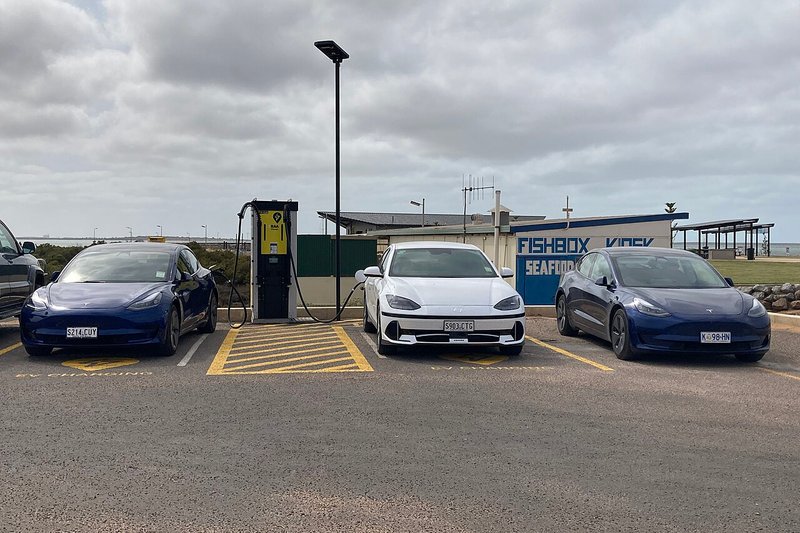
The 800V E-GMP platform supports 350kW DC peak charging. At Chargefox ultra-rapid stations, 10 to 80 per cent takes around 18 minutes. At 150kW CCS stations - the majority of public fast chargers in Australia - the car runs at the station’s maximum output.
V2L is standard. The 3.6kW exterior port handles camping equipment, power tools, and basic household appliances. V2H is not supported on current Australian models.
AC home charging at 11kW (three-phase) fills the 77.4kWh pack in approximately 7.5 hours.
Interior and Technology
The Ioniq 6’s cabin is narrower than the Ioniq 5 - the aerodynamic silhouette requires a reduced cross-section. Five adults technically fit, but rear shoulder room is noticeably tighter than in the Ioniq 5. Two adults in the rear are comfortable; three is a compromise.
Front occupants have the better of it. The dual 12-inch screen setup (infotainment and cluster) in a continuous horizontal housing performs well, and physical rotary controls for temperature and fan speed are retained below the screen. The simplified interior eliminates most of the visual clutter present in conventional cars.
Australian Ioniq 6 models include digital side mirrors - actual camera displays inside the door rather than traditional glass. They take several days to feel natural but provide better visibility in rain and at night once adapted.
Heat pump climate control is standard. Over-the-air updates are supported. The full active safety suite - Highway Driving Assist, Forward Collision-Avoidance, Blind-Spot Collision-Avoidance - carries over from the Ioniq 5.
No Apple CarPlay or Android Auto. Same limitation as the broader Hyundai range.
Practicality
Boot: 401L, reduced from the Ioniq 5 by the sloping roofline. The frunk on the Ioniq 6 is effectively non-functional (0.5L) - charging cables go in the boot. Rear headroom is sufficient for passengers under 180cm; taller occupants will find their head close to the roofline.
Towing: 1,500kg braked - 100kg less than the Ioniq 5 but still covers jetskis, standard trailers, and small boat trailers.
Safety
Five-star ANCAP. Full suite across all variants: Forward Collision-Avoidance with pedestrian and cyclist detection, Lane Following Assist, Highway Driving Assist, Blind-Spot Collision-Avoidance, Rear Cross-Traffic Collision-Avoidance.
Running Costs and Ownership
Electricity: Outstanding efficiency. At $0.30/kWh, approximately $3.70 per 100km - one of the lowest figures for any EV sold in Australia. The aerodynamic advantage is most evident on highway routes where it reduces energy consumption relative to boxier competitors.
Warranty: Five years unlimited kilometres on vehicle; ten years on the battery. Identical to the rest of the Hyundai EV range.
Servicing: Annual inspection model; typical cost $200-$350 per year.
Verdict
The Ioniq 6 RWD is for buyers who want maximum range from minimum battery - and who understand that achieving that requires accepting a narrower, lower interior than the Ioniq 5. For solo commuters and couples, the trade-off is invisible. For regular families of four or five, the Ioniq 5 Elite offers comparable charging speed, a more spacious interior, and only 23km less WLTP range for a broadly similar price. The Ioniq 6 is the car for those who prioritise efficiency and range as primary criteria.
Frequently Asked Questions
How does Ioniq 6 range compare to Tesla Model 3 Long Range?
The Ioniq 6 RWD delivers 614km WLTP versus 629km for the Model 3 Long Range - effectively equal. Real-world highway driving at 110 km/h returns comparable results. The Ioniq 6 adds V2L, a stronger warranty, and 350kW DC charging; the Model 3 has the Supercharger network advantage.
Does the Ioniq 6 have a frunk?
The frunk on Australian Ioniq 6 models has approximately 0.5L of space - functional only for very small items. Charging cables and luggage go in the 401L boot.
What does a Cd of 0.21 mean in practice?
It means the car encounters less aerodynamic resistance at speed than any other production vehicle. At 110 km/h, this translates to measurably lower energy consumption per kilometre compared to less aerodynamic EVs - and it means the Ioniq 6 extracts more range from a given battery size than alternatives with the same pack.