Gridly
Overview
The Ioniq 5 Elite takes the already-strong Standard Range and extends it in the one dimension that determines whether a car is genuinely usable on Australian interstate routes: battery size. The 84kWh pack delivers 591km of WLTP range in RWD configuration - enough for Sydney to Melbourne with one charge stop rather than two, and enough to reach Alice Springs from Darwin with planned rest stops that would be taken regardless.
The E-GMP platform that underpins every Ioniq 5 was designed with 800-volt electrical architecture from inception. Most EVs use 400V systems; the 800V difference allows higher power to move through smaller cables, reducing heat buildup and enabling sustained charge rates that fall away more slowly as the battery fills. The practical effect at a 350kW-capable Chargefox ultra-rapid charger is that the Ioniq 5 Elite moves from 10 to 80 per cent in under 18 minutes - a figure that competes directly with Tesla’s Supercharger times despite the absence of a proprietary network.
Pricing & Variants
| Variant | Battery | WLTP Range | DC Charging | Price |
|---|---|---|---|---|
| Ioniq 5 Standard Range | 63kWh | 429 km | 220kW | ~$64,900 |
| Ioniq 5 Elite | 84kWh | 591 km | 350kW | ~$72,900 |
| Ioniq 5 N Line AWD | 84kWh | 548 km | 350kW | ~$79,900 |
The Elite’s $8,000 premium over Standard Range buys a larger battery, more range, higher DC charge speed, and a more complete interior specification. Against the N Line AWD above it, the Elite gives up dual-motor performance but gains 43km of WLTP range - useful for those prioritising efficiency over acceleration.
Performance
A single rear motor produces 225kW and 350Nm. The 0-100 km/h time of 7.3 seconds is unremarkable for the class but sufficient for confident highway driving. What matters more in practice is that EV torque is available from zero rpm - there is no rev-building or gear selection required. The Ioniq 5 Elite pulls cleanly from any speed, making it easy to manage on freeway merges and in variable traffic flow.
The long wheelbase geometry produces a ride quality that separates the Ioniq 5 from most competitors. The 3,000mm wheelbase - longer than a BMW 5 Series - means the front and rear axles encounter road imperfections with a delay that smooths the car’s response. At motorway cruising speed, the cabin is composed and quiet.
One thing to note: the rear-wheel-drive layout is well-suited to the car’s driving character. Wet-road traction is good given the weight bias toward the rear battery pack, and modern traction control systems intervene quickly, but buyers in consistently wet climates or those who tow regularly should consider the N Line AWD.
Range and Charging
The 591km WLTP figure translates to 490 to 530km in Australian highway conditions at 110 km/h with climate control running. Cold mornings reduce this by 30 to 50km. Urban cycling returns 550 to 580km, reflecting the recovery available through regeneration.
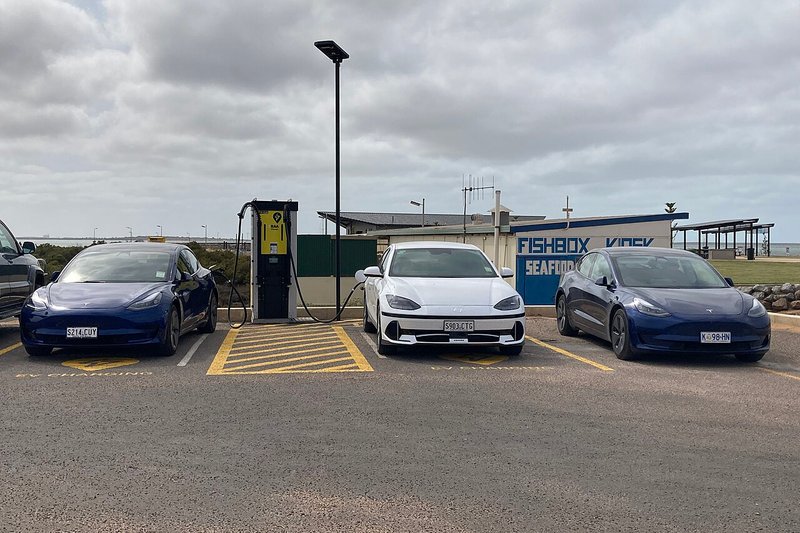
The 800V platform and 350kW DC peak charge rate are the headline charging specifications. In Australia, Chargefox ultra-rapid stations at highway locations support up to 350kW - the Ioniq 5 Elite will accept the full rate these stations offer. At a 150kW CCS station (the current majority of public DC infrastructure in Australia), the car charges at the station’s maximum output.
For daily driving, an 11kW three-phase wallbox charges the 84kWh pack in approximately 8.5 hours overnight. Standard single-phase 7.4kW takes around 12 hours.
V2L capability is standard. The 3.6kW exterior port handles tools, appliances, and camping equipment. V2H (Vehicle-to-Home) is not currently supported on Australian-spec models.
Interior and Technology
The 84kWh Elite shares the Standard Range’s platform-derived interior architecture: flat floor, floating console, generous rear legroom. The Elite adds heat pump climate control - important for range efficiency in cold conditions - ventilated front seats, a larger sunroof, and an upgraded 8-speaker Bose audio system.
The 12.3-inch infotainment and 12.3-inch digital cluster sit in a continuous horizontal housing. The interface is responsive and maps well on the wide display. Navigation includes real-time EV routing with charge stop planning based on current battery state.
Apple CarPlay and Android Auto are absent. This is a consistent criticism from Australian reviewers and buyers accustomed to native phone integration. Hyundai’s own system handles navigation and media adequately, but the absence of CarPlay in particular is a notable gap at this price point.
Over-the-air software updates are supported. The Elite includes Highway Driving Assist - lane centring combined with adaptive cruise - which handles most Australian motorway driving conditions effectively with hands on the wheel.
Practicality
Boot: 531L, wide and flat. Frunk: 24L, functional for charging cables and small bags. The interior storage system - floating console with sliding bin, wide door pockets, deep rear armrest - provides more accessible day-to-day storage than the spec sheet conveys.
Five adults. The rear bench genuinely accommodates two tall adults. Rear USB-C ports are standard. Towing is rated at 1,600kg braked - an improvement on Tesla Model 3 variants and most hatches and sedans in this category.
Safety
Five-star ANCAP. Full active safety suite including:
- Forward Collision-Avoidance Assist with pedestrian, cyclist, and junction detection
- Lane Keeping Assist and Lane Following Assist
- Blind-Spot Collision-Avoidance Assist
- Rear Cross-Traffic Collision-Avoidance Assist
- Highway Driving Assist (combined lane centring and adaptive cruise)
- Safe Exit Warning and Driver Attention Warning
Running Costs and Ownership
Electricity: At $0.30/kWh residential, approximately $4.30 per 100km. Rapid charging adds cost but still undercuts petrol significantly.
Servicing: Annual inspection model. No engine oil or transmission service. Typical annual spend: $250 to $380.
Warranty: Five years, no kilometre cap on the vehicle. Ten years on the high-voltage battery pack. Both figures exceed Tesla’s coverage at this price.
Incentives: The FBT exemption for zero-emission vehicles below the luxury car tax threshold applies. Novated lease calculations show material net-cost reductions for eligible income brackets.
Verdict
The Ioniq 5 Elite positions itself at the intersection of range, charging speed, and practical value better than almost anything at its price in the Australian market. 591km WLTP and 350kW DC charging on an 800V platform - without the proprietary network lock-in of Tesla or the premium pricing of European equivalents - is a genuinely competitive combination. The warranty, the V2L, and the flat-floor interior complete the picture. The absence of CarPlay is the one legitimate frustration; every other limitation reflects considered trade-offs rather than omissions.
Frequently Asked Questions
What is the real-world range of the Ioniq 5 Elite in Australia?
Highway driving at 110 km/h with air conditioning active returns 490 to 530km. Urban and suburban cycling delivers 550 to 580km. Cold weather - Alpine regions, southern Tasmania in winter - reduces the lower bound to approximately 430 to 460km.
How fast does the Ioniq 5 Elite charge on a 350kW DC charger?
10 to 80 per cent in approximately 18 minutes at a 350kW-capable station. The 800V architecture allows the car to accept the full output of Australia’s fastest public chargers. A 150kW CCS station - the most common public DC type currently - takes approximately 28 to 32 minutes for the same 10-80% window.
Does the Ioniq 5 Elite have Apple CarPlay?
No. Neither the Elite nor any other Ioniq 5 variant supports CarPlay or Android Auto. Hyundai’s integrated infotainment handles navigation and media, but buyers accustomed to phone integration will need to adapt.
How does the Ioniq 5 Elite compare to the Tesla Model 3 Long Range?
The Model 3 Long Range ($67,900) has a more developed charging network and slightly longer WLTP range (629km vs 591km). The Ioniq 5 Elite counters with V2L, a substantially more spacious interior, a stronger warranty, 350kW DC charge speed, and 1,600kg towing versus the Model 3’s 910kg. For interstate-focused buyers, Tesla’s Supercharger network is a meaningful advantage; for everything else, the Ioniq 5 is the more rounded vehicle.