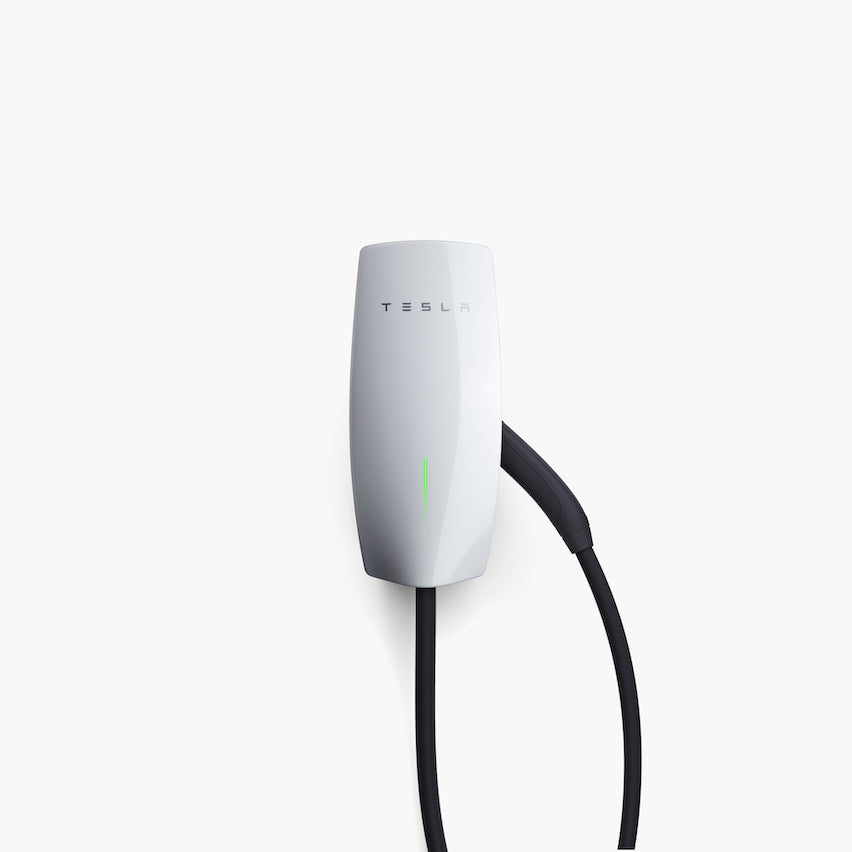
Tesla Wall Connector Gen 3 (22kW)

Strengths

  • βœ“ 7.3m tethered cable - longest in the residential category
  • βœ“ 22kW 3-phase capable - charges any 11kW OBC vehicle at full speed
  • βœ“ 4-year warranty - beats most European competitors at this price
  • βœ“ $800 - exceptional price-to-output ratio for 22kW
  • βœ“ App scheduling via Tesla app (Tesla vehicles) or third-party apps
  • βœ“ No OCPP dependency - simple setup, no cloud backend issues

Watch out for

  • βœ— No OCPP - cannot integrate with Home Assistant or third-party platforms
  • βœ— No solar integration - fixed schedule only, no dynamic solar diversion
  • βœ— No load management - does not monitor main switchboard draw
  • βœ— Maximum current on single-phase homes limited to 7.4kW regardless

Tesla

Wall Connector Gen 3 (22kW)

22 kW 3-phase Level 2 EV charger with 7.3m tethered cable

$1,000 AUD

Model

Wall Connector Gen 3 (22kW) Wall Connector Gen 3 (7kW) β€” $800

Our Verdict

The Tesla Wall Connector Gen 3 is one of the best value 22kW home chargers in Australia. The 7.3m tethered cable solves the most common complaint about home chargers, the 4-year warranty beats most European alternatives, and $800 is genuinely competitive for 22kW capable hardware. The trade-offs are no OCPP and no solar integration - if you want to charge from solar surplus, the Zappi or Fronius Wattpilot are better tools. For most households wanting fast, reliable home charging with minimal setup, this is the pick.

22 kW3-phaseType 2TetheredIP55
Key Features
Max Output 22 kW
Phases 3-phase
Smart Charging Yes
Solar Integration No
App Control Yes
OCPP No
Specifications
Type
Level2-22kW
Max Output
22 kW
Phases
3-phase
Connector
Type 2
Tethered Cable
7.3m
Smart Charging
Yes
App Control
Yes
Solar Integration
No
Scheduling
Yes
Load Management
No
OCPP
No
IP Rating
IP55
Warranty
4 years
Installation
Licensed electrician
Compatible Vehicles
All Type 2 EVs
Warranty & Installation
βœ“

4-year warranty β€” contact the manufacturer or installer for full warranty terms.

βœ“

Professional installation required β€” must be installed by a licensed electrician under Australian wiring rules.

You might also consider

Overview

Tesla’s Wall Connector Gen 3 is Australia’s most popular home EV charger by installation volume - driven partly by Tesla owners buying from the Tesla ecosystem, but more significantly by how compelling the value proposition is for any EV household. At $800 for a 22kW-capable charger with a 7.3m cable and a 4-year warranty, it undercuts European competitors with equivalent output by $500–$1,400.

The absence of OCPP is the meaningful limitation. Tesla has no plans to add it - the Wall Connector is designed for simplicity, not integration. For households that want solar diversion or third-party home automation integration, this isn’t the right tool. For everyone else, it’s hard to beat.


Specs at a glance

SpecDetail
Max output22kW (3-phase) / 7.4kW (single-phase)
Cable7.3m tethered Type 2
IP ratingIP55
OCPPNo
Solar integrationNo
Load managementNo
Warranty4 years
Price$800

The 7.3m cable advantage

The most practically significant spec on this unit is the 7.3m tethered cable. Most competitors offer 5–6m - adequate for garages where the charger mounts close to where the vehicle parks, but limiting for:

  • Long garages where the charger mounts at the wall and the car’s charge port is at the far end
  • Carports where the charger is on a side wall with variable parking position
  • Properties where vehicles park nose-in versus reverse-in depending on the day

The extra 1.3–2.3m of cable that the Tesla Wall Connector provides over competitors is a genuine quality-of-life advantage that gets used daily. It is the reason many installers recommend this charger even for non-Tesla households.


Installed cost

Cost componentTypical range
Wall Connector supply$800
Professional installation$400–$700
Total all-in~$1,200–$1,500

This is the most affordable 22kW-capable installed home charger in Australia. The Wallbox Pulsar Plus 22kW ($1,581 supply) installs at $2,200–$2,500. The Tesla Wall Connector at $1,200–$1,500 installed achieves the same maximum output at roughly half the total cost.


Single-phase vs three-phase: what speed you’ll actually get

Most Australian homes have single-phase power. On single-phase:

  • Tesla Model 3/Y: charges at 7.4kW (OBC limits to 7.4kW on single-phase, despite 11kW rating)
  • BYD Atto 3, Seal: 7.4kW (these have 7.4kW single-phase OBCs)
  • Hyundai IONIQ 5/6: 7.4kW
  • MG4: 7.4kW

On three-phase supply with an 11kW OBC vehicle:

  • Tesla Model 3/Y: 11kW
  • Hyundai IONIQ 5/6: 11kW
  • VW ID.4: 11kW

For a household charging a Tesla Model Y overnight: 11kW of charge for 8 hours adds approximately 540km of range from empty. 7.4kW adds approximately 370km. Either is more than sufficient for typical daily driving patterns.


No OCPP: when it matters and when it doesn’t

OCPP (Open Charge Point Protocol) enables integration with:

  • Home automation systems (Home Assistant)
  • Third-party solar energy management
  • Commercial charge point management systems
  • Time-of-use tariff optimisation via external platforms

The Tesla Wall Connector doesn’t have it. For Tesla owners, scheduling within the Tesla app (set charge limit, schedule departure time, set charge window) replaces much of what OCPP provides for other brands.

For non-Tesla owners: the lack of OCPP means charging schedules must be set via a basic app (if available) or via the car’s own charging schedule. Most modern EVs allow the vehicle itself to schedule charging start times, which covers off-peak timing without needing charger-level OCPP.

The scenarios where OCPP genuinely matters:

  1. Households running Home Assistant with energy management automation
  2. Properties with multiple chargers needing central management
  3. Solar-aware dynamic charging (the Wall Connector has no CT clamp capability)

For households with solar panels who want to charge from surplus, the Zappi 7kW ($1,350) or Fronius Wattpilot ($1,800) are the alternatives.


Who should buy the Tesla Wall Connector Gen 3

Best for:

  • Any household wanting the longest cable and best warranty at the lowest price
  • Tesla owners who want tight app integration and guaranteed compatibility
  • Non-Tesla owners who don’t need OCPP or solar diversion
  • Budget-conscious buyers who want 22kW capability with a 4-year warranty
  • Renters or first-time EV owners who want straightforward charger setup

Skip if:

  • You have rooftop solar and want to charge from surplus - the Zappi or E2 Plus do this
  • You need OCPP for Home Assistant or fleet management
  • Load management is required for an older home with limited switchboard capacity
Frequently Asked Questions

01 Does the Tesla Wall Connector Gen 3 work with non-Tesla cars?

Yes. The Tesla Wall Connector Gen 3 uses a Type 2 (IEC 62196) connector, which is the Australian standard for AC home charging. It is compatible with all EVs sold in Australia - BYD, Hyundai, Kia, MG, Volkswagen, BMW, Mercedes-Benz, Polestar, and any other Type 2 vehicle. Tesla vehicles connect directly. Non-Tesla vehicles use the Type 2 connector on the cable.

02 What is the total installed cost of the Tesla Wall Connector Gen 3?

Supply price is $800. Professional electrician installation adds $400–$700 depending on cable run length, switchboard proximity, and whether a new 32A circuit is needed. Total all-in cost is typically $1,200–$1,500 - one of the most affordable installed 22kW options in Australia.

03 What charging speed does the Tesla Wall Connector provide on single-phase power?

On single-phase supply (most Australian homes), the Tesla Wall Connector charges at 7.4kW maximum, regardless of its 22kW nameplate. 22kW requires three-phase supply AND a vehicle with a 3-phase 11kW+ onboard charger. Tesla Model 3 and Y have 11kW 3-phase OBCs, so on 3-phase supply they charge at 11kW.

04 Does the Tesla Wall Connector have OCPP?

No. The Tesla Wall Connector does not support OCPP. Scheduling is handled via the Tesla app for Tesla vehicles, or via third-party scheduling apps for non-Tesla EVs. It cannot be integrated with Home Assistant, SolarEdge, or commercial charge point management systems. For open OCPP integration, the Wallbox Pulsar Plus or ZJ Beny 7kW are alternatives.

05 How does the Tesla Wall Connector compare to the Wallbox Pulsar Plus?

Tesla Wall Connector Gen 3: $800, 22kW, 7.3m cable, 4yr warranty, no OCPP. Wallbox Pulsar Plus 7kW: $1,345, 7.4kW, 5m cable, 2yr warranty, open OCPP. The Tesla is significantly cheaper, has a longer cable and better warranty - it loses only on OCPP and load management. For households not needing third-party OCPP integration, the Tesla is the better value proposition.

06 Can I charge at 22kW with the Tesla Wall Connector at home?

Only if your home has three-phase power supply AND your vehicle supports three-phase AC charging. Most Australian suburban homes have single-phase power. Tesla Model 3 and Y have 11kW (not 22kW) AC OBCs, so even on 3-phase you'll charge at 11kW. The 22kW maximum applies in commercial or industrial 3-phase installations. For home use, 7.4kW (single-phase) or 11kW (3-phase) are the practical speeds.